
Student Life, the people that do “Popcorn Wednesdays” and work with “the clubs and stuff” aka “the activities and games people who give away free food all the time”… you get the idea! We love that students and staff think about College of DuPage (COD) Student Life when they think of fun and food, however, we are also home to so much more including the college’s New Student Orientation and co-curricular leadership development programs. In recent years, we have seen a large increase in the number of clubs and involved students on our campus. We have essentially doubled in size from 40 to 80+ clubs since 2010!
While we cannot 100% attribute this involvement boom to any one reason, we have seen increasing numbers of students at New Student Orientation each year. The sheer number of students connecting with our office has required we increase our programming and services. Bottom line, this growth has put a strain on our 7-person team. Within the last year we realized the upward trajectory was not sustainable with our current systems and functions. Our team knew we had to start think about a new ways to serve the 27,000 students of COD and our 1000+ student club and organization members and advisors. Where to start?
Background
In spring 2016, Student Life started on a journey through the process of Appreciative Inquiry (AI). The office had arrived at a critical point in meeting the needs of a growing population. AI was used as a tool to think about how the office could sustain high levels of service and support to a growing number of clubs and involved students at College of DuPage.
Why AI?
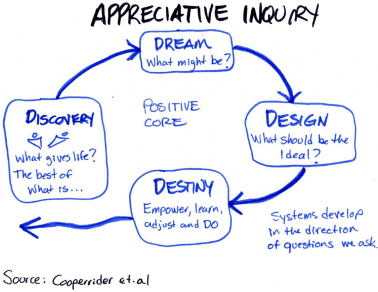 AI is a strengths-based, capacity building approach to transforming human systems; the practice explores what gives life to human systems when they function at their best (Barrett & Fry, 2005; Ludema, Whitney, Mohr, & Griffin, 2003). AI seeks to change the way organizations approach change by removing the use of deficit language and the traditional focus on problem-solving practices. This change is realized by exploring and leveraging the strengths in organizations to create an ideal future. It incorporates positive feedback and storytelling, but that is not to say that AI simply ignores problems that exist in organizations. AI advocates the position that focusing on problems does not necessarily equal improved outcomes in those identified problem areas.
AI Principles and Process
The AI approach has four main principles. The process must:
- begin with appreciation of what works,
- it must generate useful knowledge to be applied in the organization,
- it must be provocative to generate images of what might be in the future,
- it must be collaborative.
The practice of AI is based on the 4-D model: discovery, dream, design, and destiny. Before an organization can jump into using AI, there are decisions to be made about the topic of the inquiry. The topic can begin with a problem but must be transformed into an affirmative topic that invites individuals to consider the possibilities of transformation with energy and enthusiasm. AI is “based on the belief that the seeds of change are implicit in the very first questions we ask, and that the way we word and frame the discussion topics dramatically affects outcomes” (Powley, Cooperrider, & Fry, 2002, p. 168).
After internal discussions, our office focused on creating an environment to be an effective, efficient, innovative, and balanced team to meet the needs of those we serve.
Timeline and Progress
Below is a map of our timeline and a recap of our progress through AI (so far). My colleague Kristina and I co-facilitated all sessions for the team. We relied heavily on The Appreciative Inquiry Summit: A Practitioner’s Guide for Leading Large-Group Change, which I highly recommend to practitioners wishing to use AI with their organizations.

Discovery to Dream Phase 3/18/16
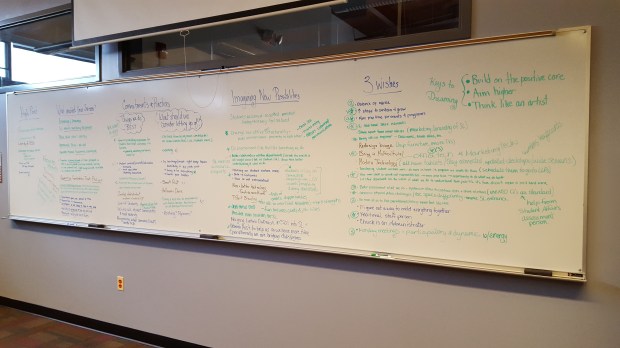
Student Life meets off-campus for a one-day retreat. The team is introduced to AI and conducts one-on-one interviews to produce a list of high point experiences, descriptions of keys to success, commitments and practices, imagining new possibilities, and three wishes for the future.
Dream Phase 3/22/16
 Team meets on-campus for a second one-day retreat. Opportunity mapping begins with the statement: “Key opportunities to creating an environment to be an effective, efficient, innovative, and balanced team.”
 Opportunity map branches into seven key focus areas: Monday meetings, marketing, physical space, technology, assessment, balance of office, and staffing.
Dream statements are crafted around the opportunity areas (V1.0). Statements are presented and undergo initial revisions (V1.1).
V1.1 of dream statements are posted in the office for priority ranking. Staff initial areas of personal interest.
Dream Phase 3/22/16 – 1/3/17 & 1/19/17
 Progress slows as the team experiences staffing transitions. Two staff members depart and two are added.
To include new perspectives on the dream statements, V2.0 is posted in the office and the staff re-prioritize the statements in preparation for another retreat.
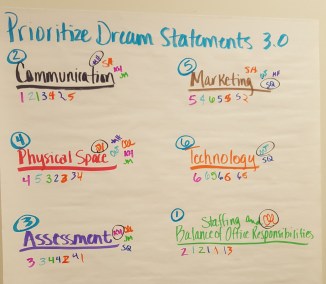
On 1/19/17, the team meets for a half-day retreat. Discussion on the dream statements leads to changes in the original statements and the creation of V3.0.
Six key focus areas emerge: communication, marketing, physical space, technology, assessment, staffing and balance of office responsibilities.
Dream to Design 1/19/17
The team finalizes dream statements and selects innovation teams with team leads assigned to each area. The top ranked opportunity is discussed as a group, and a timeline is set to move forward. The remaining opportunities are released to each team lead to organize and move forward.
Information on Design Thinking and action planning is shared to be used as tools by each innovation team.

Design to Destiny 1/19/17-6/1/17
The next retreat date is set for 6/1/17 where a check in on all innovation teams will take place.
Reflecting on the Use of AI
In the year since we started our AI journey, we have faced challenges. We have had changes in institutional leadership, new policies and procedures have been implemented at the institutional level that require immediate response, and we continue to experience regular turnover of our student leaders and club advisors. Despite the continuous change, we have managed to make time to step back and continue on this path. We know that we are making an investment in the long-term success of the office. I am thrilled that we have arrived at the designing stage.
Throughout the process I have observed our team critically look at the bigger picture of what, why, and how we do our work. We are capitalizing on our strengths through AI; leveraging the individual talents AND our ability to adapt to new and changing circumstances. We are transforming into a team that learns. On-boarding new staff members through this process has been an additional challenge, but as we have started working in our innovation teams they have jumped in bringing new ideas and fresh perspectives. I am looking forward to designing and rolling out our new ideas in the coming year. I will be giving an update when we do – stay tuned!
References
Barrett, F. J., & Fry, R. E. (2005). Appreciative Inquiry: A Positive Approach to Building Cooperative Capacity. Chagrin Falls, OH: Taos Institute Publications.
Ludema, J. D., Whitney, D., Mohr, B. J., & Griffin, T. J. (2003). The Appreciative Inquiry Summit: A Practitioner’s Guide for Leading Large-Group Change. San Francisco, CA: Berrett-Koehler Publishers, Inc.
Powley, E. H., Cooperrider, D., & Fry, R. E. (2002). Appreciative inquiry: A revolutionary approach to strategic change. Publishers of Journal of Business Strategy: 2002 handbook of business strategy (pp. 165-172). NY: EC Media Group.
 Stephanie Quirk